

7 Signs of a Fake Sports Autograph to Check Before You Buy
Last Updated: November 1, 2026
Quick Summary
To spot fake sports autographs, ask the seller for clear close-up photos, then compare the signature with confirmed examples from the same player. Look at the ink and pen strokes for natural pressure variation, check the item's condition, and verify the certificate and seller before paying.
- Request close-up photos of the signature, item and certificate, and treat refusals as a warning sign.
- Genuine signatures show small variations in pressure and speed, while identical copies can point to tracing or printing.
- Sharp, uniform lines or ink sitting flat on the surface can suggest a printed or stamped signature.
- Match a certificate's number to the item's sticker and to the issuer's records before relying on it.
- Visual checks can flag fakes but cannot prove authenticity, so use professional authentication for valuable items.
Table of Contents
- Why Fake Sports Autographs Are So Common
- Step-by-Step: How to Verify an Autograph Before You Buy
- Signs of a Fake Autograph Your Eyes Can Catch
- Autograph Certificate of Authenticity: What It Does and Doesn't Prove
- Checking Sports Autograph Provenance Before You Pay
- Your Next Step: Buying Signed Memorabilia With Confidence
- Frequently Asked Questions
Why Fake Sports Autographs Are So Common
Fake sports autographs are everywhere, and the market for signed memorabilia rewards forgers who work hard at their craft.
Most fakes are not crude scribbles. Many are traced, printed or produced by someone who has studied a player's hand for years. That is why a quick look at a signature often isn't enough.
The good news is that most fakes give themselves away once you know what to look for.
Step-by-Step: How to Verify an Autograph Before You Buy
- Ask for clear photos. Request close-up images of the signature, the item and any certificate. Sellers who refuse are a warning sign.
- Compare the signature with verified examples. Look at confirmed signatures from the same player.
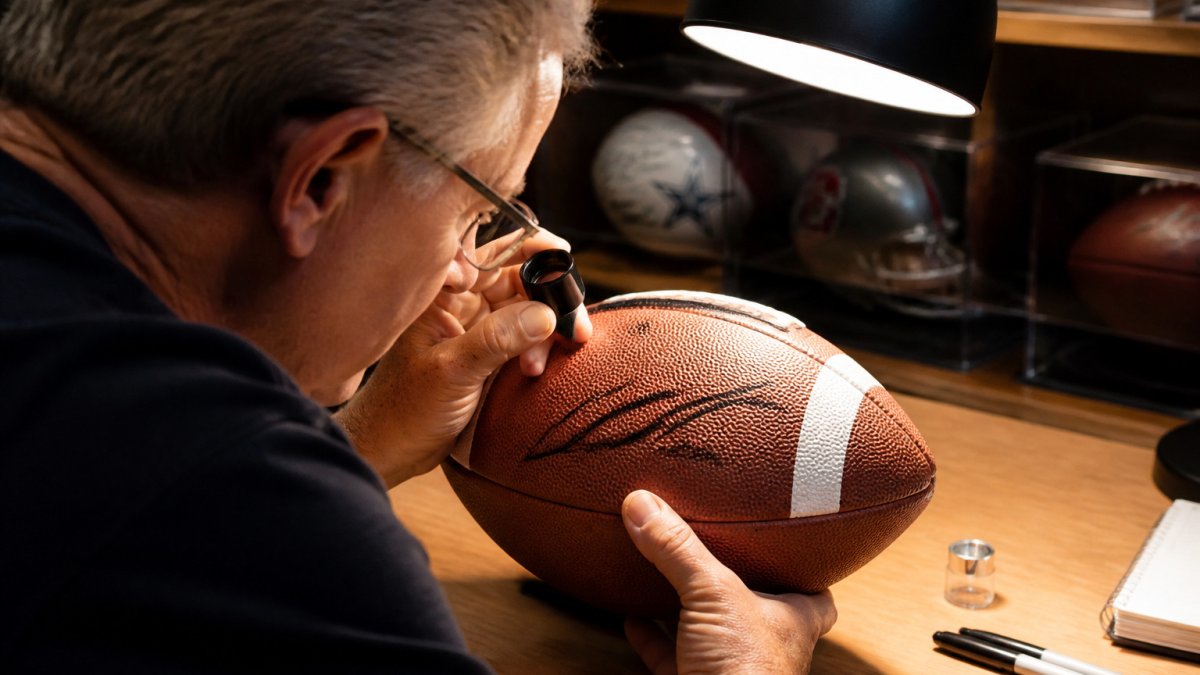
- Inspect the ink and pen strokes. Check how the ink sits and how the pen moved.
- Check the item's condition. Look for signs of age, handling or alteration.
- Read the certificate carefully. Confirm what it says and who issued it.
- Research the provenance. Ask where the item came from and whether the history holds up.
- Check the seller. Look at their track record, returns policy and contact details.
Compare the signature with verified examples
Place the signature next to several confirmed examples from the same player. Look for consistent letter shapes, spacing, slant and overall flow. A real autograph varies slightly from one signing to the next, but the core formation stays the same.
Be careful with signatures that look too perfect. Genuine signatures show small variations in pressure and speed; an identical copy every time can point to a traced or printed signature.
Inspect ink, pen strokes and pressure marks
Look closely at the ink. Genuine signatures usually show natural pen pressure, with thicker and thinner lines where the pen slowed or sped up. Sharp, uniform lines can suggest a printed or stamped signature.
Check the surface too. Ink that sits on top of the paint or leather finish of a football, or that bleeds into a shirt fabric in an odd way, deserves a closer look.
Signs of a Fake Autograph Your Eyes Can Catch
Most fakes fall into a handful of methods, and each leaves its own tell. Knowing which method you are looking at makes the warning signs far easier to read.
Common forgery methods and their telltale signs
- Hand-forged copies. Someone studies a player's signature and reproduces it by hand. The tell is hesitation: lines that slow down, wobble or stop and restart, and letter shapes that drift between examples. Genuine signatures flow because the signer has written the name thousands of times.
- Traced signatures. The forger places a genuine signature underneath and traces it. The result often looks too perfect and too slow, with uniform pressure and no natural speed variation. Look for faint indentation lines or pencil guide marks.
- Stamped signatures. A rubber stamp or autopen machine reproduces the signature. The tell is mechanical uniformity: identical line weight, flat ink with no pressure variation, and sometimes a faint halo where the stamp met the surface.
Item-specific checks
A photo, a shirt, a ball and a trading card each fail in different ways:
- Photos and prints. Check the signature against the photo's age. Ink that sits on top of a glossy finish without any bite, or that looks fresher than the paper's yellowing, deserves a closer look. Look for a signature that runs off the edge of a printed border in a way a real signer would not have done.
- Shirts. Genuine signatures on fabric usually bleed slightly into the weave. Ink that sits on the surface like paint, or that has cracked and flaked in a way the fabric has not, is worth questioning. Check that the signature is on the part of the shirt a player would actually have signed.
- Balls. Ink on leather or synthetic panels behaves differently from ink on paper. Look for pressure marks and a natural taper at the end of strokes. A signature that is perfectly centred and identical to a catalogue image is a warning sign.
Sport- and athlete-specific variation
Signatures change over time. A player's early-career autograph can look quite different from a later one, and signatures made at a crowded signing session are often quicker and looser than ones signed at leisure. Compare like with like: match the era, the signing context and the item type before you decide a signature is wrong. Natural variation is not forgery, and treating it as such is one of the most common mistakes buyers make.
What your eyes cannot do
Visual checks can raise suspicion, and several warning signs together are a strong reason to walk away. But visual inspection cannot reliably prove authenticity, a good forgery can pass every check on this list. When the item is valuable, or the checks leave you uncertain, professional authentication is the right next step, and even authentication is an opinion, not a guarantee.
Autograph Certificate of Authenticity: What It Does and Doesn't Prove
A Certificate of Authenticity (COA) can add confidence, but it is only as good as the company that issued it and the checks behind it. A certificate shows that someone claims the signature is genuine; it does not prove that claim on its own, and a forged certificate is one of the cheapest props in the counterfeit trade.
Bukayo Saka Hand Signed Football, Beckett Authenticated £299 →
What a COA should contain
A credible certificate is specific, not generic. Check that it names the signer, describes the exact item (for example, 'signed match shirt, 2023-24 home kit, signed in black marker on the back number'), states the date or event of signing where known, and carries a unique certificate or authentication number. A certificate that could apply to any item in a warehouse is worth very little.
How to verify a certificate and authentication record
Work through these checks before you rely on a COA:
- Match the number to the item. The certificate number should appear on the certificate, on any accompanying hologram or sticker, and in the issuer's records. If the number on the certificate does not match the sticker on the item, stop.
- Check the issuer's database. Reputable authentication companies publish searchable records. Enter the certificate number and confirm the record matches the signer, the item type and the date. A number that returns no record, or a different item, is a red flag.
- Confirm the issuer exists and has a track record. Look for a real business address, a contact route and a history of authentication work. An issuer with no verifiable presence beyond the certificate itself adds little.
- Check the physical certificate. Genuine certificates are usually printed on branded stock with security features such as holograms, embossing or unique reference numbers. A plain photocopy with no traceable issuer is easy to produce and easy to forge.
- Match the documentation to the exact item. The certificate should describe the item in front of you, the shirt, the ball, the photo, not a similar one. Photographs of the signing session, where available, should show the same item.
Where certificates fall short
A COA is a claim, not a guarantee. Certificates can be forged, copied from a genuine item and paired with a fake, or issued by a company that never inspected the signature properly. Treat the certificate as one strand of evidence alongside the signature itself, the item's condition and the provenance.
Read any certificate carefully, check it against the item in front of you, and confirm the signer's name, the item description and the issuer's details all line up.
Before relying on a certificate, check that it matches the item and the issuer's records.
| Check | What to confirm | Red flag |
|---|---|---|
| Certificate number | Matches the item's sticker and the certificate | Numbers do not match |
| Issuer database | Record shows same signer, item and date | No record, or a different item |
| Issuer presence | Real business address and contact route | No verifiable presence |
| Physical certificate | Branded stock with security features | Plain photocopy, no traceable issuer |
| Item description | Describes the exact item in front of you | Generic or similar item |
Checking Sports Autograph Provenance Before You Pay
Provenance means the documented history of an item: where it came from, who owned it and how it changed hands. Strong provenance makes a genuine signature easier to trust.
Ask the seller direct questions:
- Where did the item originate?
- Was it signed in person, at an event or through a known signing session?
- Who has owned it since?
If the answers are vague, or change from one conversation to the next, pause before you buy. Good sellers can explain the history clearly and will not mind you checking.
Your Next Step: Buying Signed Memorabilia With Confidence
Before you buy, run through the seven checks above and make sure the item, the certificate and the seller all line up. If you are considering a signed football, our Bukayo Saka Signed Football, Beckett Authenticated In A Acrylic Case (£350) is one option to look at. Read the listing, compare it against the checks in this guide, and ask any question you still have before ordering.
Take your time with every purchase. A careful check now is far better than discovering a fake after the money has gone.
Frequently Asked Questions
How do I verify an autograph?
Start by comparing the signature with verified examples from reputable sources, looking at letter formation, spacing, slant and flow. Then inspect the ink and pen pressure, check whether the item shows signs of mechanical reproduction, and review any Certificate of Authenticity alongside the seller's history. No single check is conclusive on its own. Visual inspection narrows the field, but the strongest protection is buying from a seller who can document how the item was signed and who signed it.
Does a Certificate of Authenticity prove an autograph is real?
Not on its own. A Certificate of Authenticity is only as reliable as the organisation or person issuing it. Many certificates are printed on generic stock or issued by bodies with no verifiable track record. Check who issued the certificate, whether it names the specific item and signer, and whether the issuer can be contacted and has a traceable history. Treat the certificate as one piece of evidence alongside the seller's reputation and the item's provenance.
How can I check the provenance of signed sports memorabilia?
Ask the seller where the item came from, when it was signed, and whether the signing was witnessed or photographed. Good sellers can explain the chain of ownership and keep records such as invoices, event details or correspondence. Gaps in the history, vague answers or reluctance to share documentation are warning signs. Keep copies of everything you receive, as these records will matter if you ever need to resell or raise a dispute.
What should I ask a seller before buying signed memorabilia?
Ask how the item was obtained, whether the signer was paid for their services, what authentication was carried out and by whom, and what your return rights are if the item proves not to be genuine. Ask for the item's full description, including signature position and size, and whether it comes with documentation. Clear, specific answers are a good sign. Evasive replies or pressure to buy quickly should prompt caution.
