

The Importance of a Certificate of Authenticity for Signed Memorabilia
Quick Summary
A certificate of authenticity is a written document confirming that a signed item is genuine and explaining where it came from. It matters because signatures are easy to copy, and the certificate shifts the burden of proof onto the seller, who must stand behind the document.
- A credible certificate names the signer, describes the item, and identifies the issuer with contact details.
- Check that the signer's name on the certificate matches the item exactly, including spelling.
- Ask the issuer to confirm the certificate using its reference number before you buy.
- Treat a certificate with no unique identifier or verifiable issuer as a weak guarantee.
Table of Contents
- What a Certificate of Authenticity Is and Why It Matters
- How a Certificate of Authenticity Confirms an Artwork's Genuineness
- What Should a Certificate of Authenticity Include
- Provenance, Ownership History and Autograph Provenance
- How Authenticity Affects Value and Resale
- How to Verify a Certificate of Authenticity and Assess Its Issuer
- What to Do When a Certificate Is Missing, Damaged or Disputed
- Certificate of Authenticity Template and Checklist for Buyers
- Booking Your Next Signed Memorabilia Purchase With Confidence
- Frequently Asked Questions
The Importance of a Certificate of Authenticity for Signed Memorabilia
Last Updated: November 8, 2026
What a Certificate of Authenticity Is and Why It Matters
A certificate of authenticity (COA) is a written document that confirms an item is genuine and explains where it came from. For signed sports memorabilia, that usually means a shirt, ball, photograph or boxing glove bearing an athlete's signature, accompanied by paperwork that identifies the item and the person who vouches for it. Without that paperwork, a buyer has only the seller's word and the signature itself, which is exactly what forgers rely on.
The reason it matters is simple. Signatures are easy to copy with practice, and a convincing fake can look identical to a real one at a glance. A good certificate shifts the burden of proof onto the seller, who must stand behind the document. Collectors, gift-buyers and charity auction organisers often rely on that paper trail when the item is expensive, sentimental or going to be resold.
A COA is no substitute for judgement, but it is the baseline any serious buyer should expect.
How a Certificate of Authenticity Confirms an Artwork's Genuineness
A COA confirms genuineness by linking a specific object to a specific signing event or source, then backing that link with a named authority. The certificate itself does not prove anything on its own. Its value depends on who issued it, how they reached their conclusion, and whether the details on the document can be checked against the object in your hands.
Independent third-party authentication can add a layer of credibility beyond a seller's own certificate. Services such as Beckett issue authentication stickers or holograms that can be traced back to the issuing company.
Genuineness is also about consistency. The signature should match the athlete's known style, the item should match its described condition, and the documentation should not contradict the object. When any of these elements disagree, a buyer should pause before paying.
What Should a Certificate of Authenticity Include
A useful certificate states clearly what it covers. At minimum, it should name the athlete, describe the item, record how the signature was obtained, and identify the issuer with contact details. The date of signing and any unique identifier, such as an edition or serial number, make the document far easier to verify later.
For signed sporting items, the following details are worth looking for:
- Full name of the signer, spelled exactly as it appears on the item
- Item description, including type (football, boxing glove, photograph), size and colour
- Signing details, such as where and when the signature was obtained, if known
- Issuer name and contact information, so the authenticity claim can be queried
- Unique reference number or hologram, linking the paperwork to the object
- Signature or stamp from the issuer, not just a printed template
Vague certificates that say only "authentic" with no supporting details give a buyer very little to check. Treat them with caution.
A useful certificate states clearly what it covers, and the details below are worth looking for on any signed sporting item.
| Detail | What it confirms | Why it matters |
|---|---|---|
| Full name of the signer | Who signed the item | Must be spelled exactly as it appears on the item |
| Item description | Type, size and colour | Lets you check the paperwork against the object |
| Signing details | Where and when the signature was obtained | Helps later verification, if known |
| Issuer name and contact information | Who vouches for the item | Allows the authenticity claim to be queried |
| Unique reference number or hologram | Links the paperwork to the object | Connects the certificate to one specific item |
| Signature or stamp from the issuer | The issuer stands behind the document | Not just a printed template |
Provenance, Ownership History and Autograph Provenance
Provenance is the documented chain of ownership for an item, from the moment it was signed to the moment you buy it. Autograph provenance focuses specifically on how the signature came to exist: who witnessed it, under what conditions, and whether there is any record of the signing event itself.
A strong provenance trail reduces the risk of buying a signature that was added later or obtained in ways the athlete would not have approved. Ownership history matters too. If an item has passed through several hands with no records, questions should be asked. A clear chain, even a short one, is more reassuring than a long story with gaps.
Why Provenance Is Not the Same as a Certificate
A certificate states what the issuer believes about an item. Provenance is the evidence that supports or undermines that belief. The two work together, but they are not interchangeable. A certificate can be issued in good faith for an item with a poor history, and a well-documented provenance can still come with a certificate that does not verify the signature itself. Buyers should ask for both, and check that they tell the same story.
How Authenticity Affects Value and Resale
Authentication is the foundation of an item's market value. A signed football or boxing glove with a credible COA can be resold with confidence, while an unauthenticated item often sells at a steep discount or not at all. Buyers in the resale market will ask for documentation first, so keeping the original certificate safe is worth the effort.
Value is not guaranteed, and no seller can promise that a signed item will rise in price. Many factors affect what collectors will pay, including the athlete's profile, the rarity of the piece and the condition of the signature. What authentication does is remove doubt, which makes an item far easier to sell when the time comes.
How to Verify a Certificate of Authenticity and Assess Its Issuer
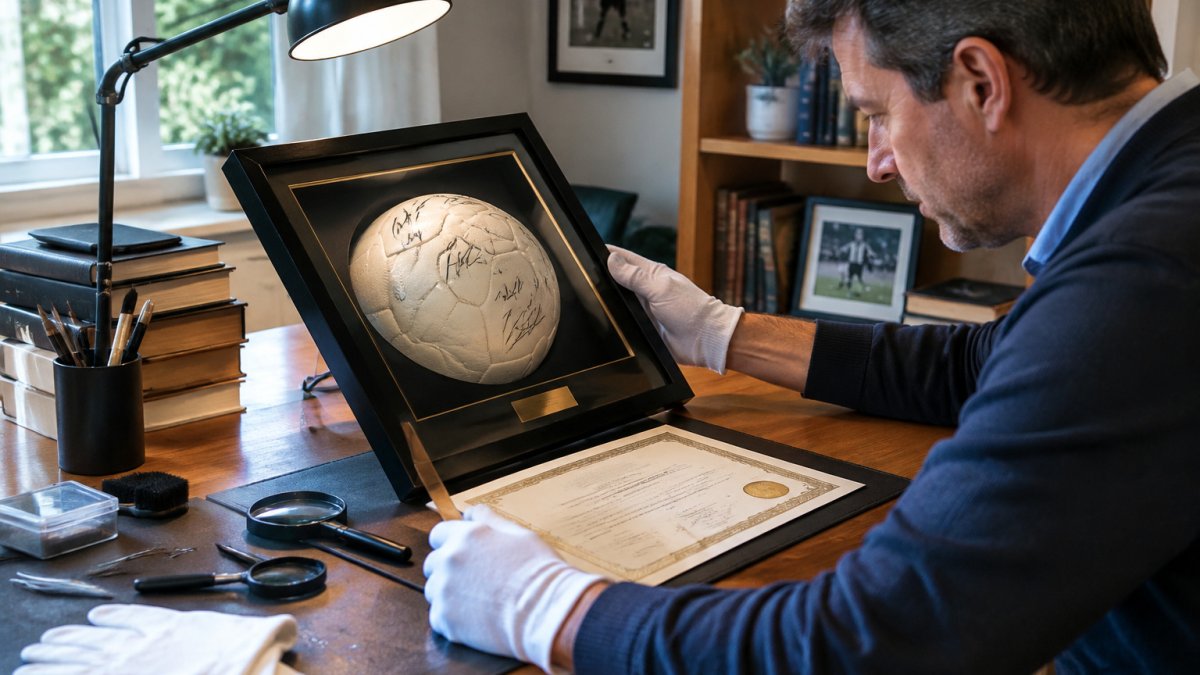
Verification is a two-part exercise: assess the issuer, then test whether the document actually ties to the object in front of you. Most buyers do the second and skip the first, which is why convincing paperwork attached to a forgery still changes hands.
Assess the issuer first. A credible issuer should be identifiable as a business or recognised authentication body. Check for a registered company name and number, a published trading address, and a contact route that is not a disposable email address. For more on judging sellers and their paperwork, see our buyer's guide to signed football shirts. Look at how long they have traded and whether their website, invoices and certificate all use the same legal entity. A common pattern is a certificate bearing a trading name that does not match any registered company, which makes the issuer effectively untraceable if a dispute arises.
Check the issuer's method, not just their name. Ask how the signature was authenticated: was it witnessed in person at a signing, examined by a specialist who compares it against known exemplars, or simply asserted by the seller? In-person witnessing and expert examination are different claims with different evidential weight, and a certificate should say which applies. If the issuer cannot explain the method in plain terms, treat the certificate as a seller's assertion rather than independent authentication.
Match the document to the object. Work through the following in order:
- The signer's name on the certificate matches the name on the item exactly, including spelling and any middle names.
- The item description (type, size, colour, framing) matches what you have in hand.
- Any reference number, hologram or tamper-evident label on the item corresponds to the number printed on the certificate.
- The signing date and location are plausible for the athlete's career and public schedule.
- The issuer's signature or stamp is present and consistent with their other documents.
Query the certificate directly. A genuine issuer should confirm a certificate on request, usually by email or an online lookup using the reference number. Send a short query quoting the reference number and asking them to confirm the item, signer and date. Keep the reply. If the issuer has ceased trading, that does not automatically make the item fake, but it does mean the certificate can no longer be independently confirmed and the item should be valued accordingly.
Know the red flags. Be cautious when a certificate is a generic printed template with no unique identifier, when the issuer's contact details are missing or bounce, when the reference number cannot be found in any register, or when the seller discourages you from contacting the issuer. Watch out: a certificate that looks professional but names an issuer with no verifiable trading history is often worse than no certificate at all, because it creates false confidence.
What to Do When a Certificate Is Missing, Damaged or Disputed
If the certificate is missing. Contact the seller first and ask whether they hold records of the sale and can reissue or confirm the documentation. Many dealers keep transaction records and can supply a duplicate or a written confirmation. If the seller cannot help, approach the issuer directly if they are still trading, quoting any reference number you have. Where neither route works, an independent authentication service can examine the item, though this normally involves a fee, takes time, and may return an inconclusive result. Gather whatever provenance you can in the meantime: receipts, auction catalogues, photographs of the signing, correspondence with the seller, and any previous valuations.
If the certificate is damaged. Photograph it before doing anything else, including close-ups of the reference number, issuer signature and any stamp. Minor wear rarely destroys the information, but illegible details make later verification harder. Store the document flat, out of direct sunlight and away from damp, ideally in an acid-free sleeve. Do not laminate it, as lamination can trap moisture and is difficult to reverse without damaging the paper.
If the certificate is disputed. Separate the two questions: whether the certificate is genuine, and whether the item is genuine. A certificate can be authentic paperwork for a forged signature, so disputing one does not settle the other. Put your concerns in writing to the seller, stating what you believe is wrong and what evidence supports that view. Keep all correspondence, photographs and the original packaging.
Use your consumer rights. Where you bought as a consumer from a trader, consumer law may give you rights if goods are not as described (Accepting returns and giving refunds: the law). A signed item sold as authentic that turns out not to be may breach those rights, and you may be entitled to a repair, replacement or refund. Raise the issue with the seller promptly, as delay can affect your position.
Escalate if needed. If the seller will not engage, you can report the matter to Trading Standards through the Citizens Advice consumer service, which passes complaints to the relevant local authority (Reporting to Trading Standards). For a sale conducted online, the platform's dispute process may be a quicker route. Where the sum involved is significant, take independent legal advice before pursuing a claim.
Distinguish a warranty from a certificate. A certificate is a statement of opinion by its issuer. A warranty is a contractual promise by the seller that the item is as described, and it is the warranty that gives you a remedy if the item proves otherwise. Check the seller's terms for what they actually promise, how long the promise lasts, and what they will do if a claim is upheld. Watch out: a certificate with no accompanying warranty leaves you with little practical recourse, however impressive the document looks.
Certificate of Authenticity Template and Checklist for Buyers
Use this checklist before you commit to a purchase:
- Issuer name, address and contact details are clearly stated
- Signer's full name matches the item
- Item description, including type and size, is accurate
- Signing details or provenance are provided where known
- A unique reference number or hologram links the certificate to the item
- The issuer will confirm the certificate when asked
- Return and dispute terms are stated in writing
A basic template for sellers and buyers to use when recording an item looks like this:
Certificate of Authenticity Item: [type of item, size, colour] Signed by: [full name of athlete] Signing details: [date and place, if known] Reference number: [unique identifier] Issued by: [issuer name, address, contact] Date of issue: [date] Signature of issuer: ____________________
Booking Your Next Signed Memorabilia Purchase With Confidence
Buying signed memorabilia is a decision worth taking slowly. Check the certificate, the issuer and the provenance before you pay, and keep the documentation safe once the item is yours. A well-documented piece is easier to enjoy, display and resell.
If you are looking for hand-signed football and boxing memorabilia with a Certificate of Authenticity supplied with every item, browse the A1 Sporting Speakers collection and ask us any questions before you buy. Our team is happy to explain the documentation for any piece in our range.
Frequently Asked Questions
What is a certificate of authenticity?
A certificate of authenticity is a written document that states an item is genuine and describes it in detail, typically naming the item, the signer, the date of signing and the issuing business. For signed sports memorabilia, it is the seller's written promise that the autograph is original. A certificate is only as useful as the reputation and accountability of whoever issued it, so buyers should check the issuer as well as the paper itself before relying on it.
What should a certificate of authenticity include?
A useful certificate names the item and its type, identifies the athlete or signer, records the signing date or event where known, describes the signature position and any witnessing, and gives the issuer's name, contact details and a signature. It should also state whether the item is a genuine original or a reproduction. Vague certificates that only say 'authentic' without these details give buyers little to check against.
Does a certificate of authenticity guarantee an autograph is genuine?
A certificate is a statement of the issuer's belief, not a guarantee in itself. Its value depends on the issuer's reputation, their track record and the evidence behind the claim. Independent third-party authentication, such as a recognised grading service, adds a separate layer of verification. Buyers should treat a certificate as one piece of evidence to weigh alongside provenance and the seller's history.
How can I verify a certificate of authenticity?
Start by checking whether the issuer is a named, traceable business with a physical address, company registration and a history of trading. Compare the details on the certificate with the item itself, including the signature position and the item's description. Ask whether the issuer has a record of past sales and whether independent authenticators have been used. A certificate from an issuer you cannot trace deserves little weight.
